FlexAttention Determinism#
Run-to-run determinism is important for workloads such as long reinforcement-learning rollouts and Mixture-of-Experts models. This guide explains how to make FlexAttention produce bitwise-identical results across repeated runs on the same hardware and software stack.
The accompanying examples/flex_determinism.py script tests the behavior described below across standard attention, decoding, grouped-query attention, and long-context shapes.
Note
This guide covers repeatability between runs with the same environment. It does not guarantee bitwise equivalence across different PyTorch or compiler versions, GPU architectures, or kernel configurations.
Recommended settings#
Forward pass#
Use static shapes and Inductor's default compilation mode:
compiled_flex_attention = torch.compile(
    flex_attention,
    dynamic=False,
    backend="inductor",
    mode="default",
)
Forward and backward passes#
Also enable deterministic Inductor reductions:
import torch
import torch._inductor.config
from torch.nn.attention.flex_attention import flex_attention


torch._inductor.config.deterministic = True

compiled_flex_attention = torch.compile(
    flex_attention,
    dynamic=False,
    backend="inductor",
    mode="default",
)
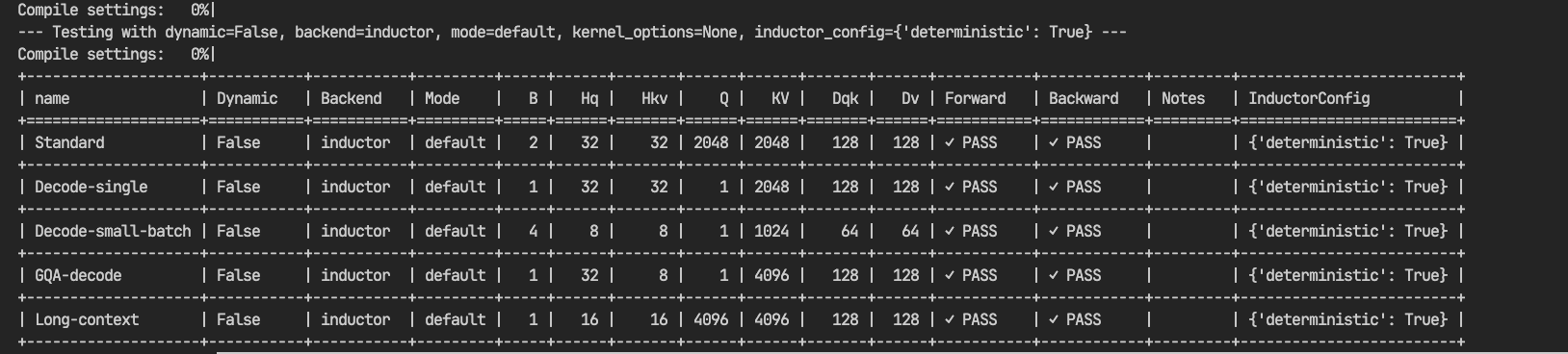
torch._inductor.config.deterministic = True is required for backward-pass determinism because FlexAttention's backward graph contains a reduction whose configuration can otherwise vary during autotuning.
Sources of numerical variation#
Several compiler and kernel choices can affect bitwise results.
Autotuning#
With modes such as max-autotune-no-cudagraphs, Inductor benchmarks multiple kernel configurations. If several configurations perform similarly, normal benchmark noise can change which configuration wins. Different block sizes or reduction strategies can perform floating-point operations in a different order, producing different bit patterns.
Resource contention can have the same effect: a competing workload may temporarily slow one candidate and change the selected configuration.
Dynamic shapes#
FlexAttention lowering uses known sequence lengths to choose block sizes and divisibility assumptions. Static and dynamic compilation can therefore produce kernels with different numerical behavior even when they receive tensors with the same concrete shapes.
Use dynamic=False when bitwise repeatability is required, and keep the shape and compilation settings consistent between runs.
Gradients for captured buffers#
When a score_mod captures buffers that require gradients, the backward pass may use atomics to accumulate those gradients. Atomic accumulation order is not deterministic. This only applies when differentiating captured buffers; it is not part of the common query, key, and value gradient path.
Why backward needs deterministic reductions#
The FlexAttention backward pass first computes a delta term equivalent to sum(output * grad_output), then uses it in the main backward kernel. This reduction is generated by Inductor rather than by the main FlexAttention kernel.
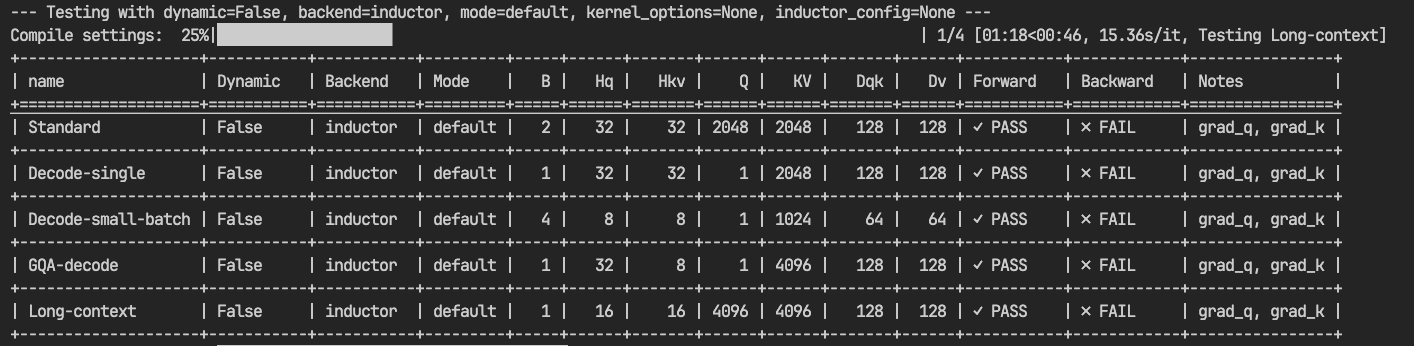
Reduction order matters for floating-point arithmetic. If autotuning selects a different reduction configuration, the delta tensor can change at the bit level. Query and key gradients depend on delta, while value gradients do not. In testing, this appeared as deterministic forward output and value gradients but non-deterministic query and key gradients.
The following run deliberately randomized autotuning choices and exposed the issue:
Enabling Inductor's deterministic mode made both forward and backward results repeatable:
The diagnosis was also confirmed with Inductor's testing-only force_filter_reduction_configs option, which restricts reduction autotuning to a consistent configuration:

These test_configs options are intended for PyTorch compiler testing and diagnosis. Use torch._inductor.config.deterministic = True in application code instead.
Determinism and performance#
FlexAttention often benefits from max-autotune-no-cudagraphs because the best kernel configuration depends on the specific score_mod, mask_mod, shape, and hardware. However, selecting a configuration at runtime introduces another source of run-to-run variation.
For both performance and determinism:
- During development, benchmark with
max-autotune-no-cudagraphsto find a good configuration for the production workload. - Record the selected FlexAttention kernel settings.
- In production, compile with
mode="default"and pass the recorded settings throughkernel_options. - Keep
dynamic=Falseand enabletorch._inductor.config.deterministicwhen backward-pass determinism is required.
Pinning kernel_options prevents FlexAttention's main kernels from changing configuration, while deterministic Inductor mode fixes the reduction configuration used by the surrounding backward graph.
Reproducing the tests#
Run the repository's determinism example on a CUDA system:
The script resets compiler state and uses fresh Inductor caches between runs so that it tests repeatability across independent compilations rather than repeatedly executing one cached kernel.
KDA determinism#
The KDA operations contain no atomics, so every kernel is bitwise-deterministic given a fixed configuration. The guarantees, strongest first:
- Same selected configurations, run to run: bitwise. Repeating a call
that resolves to the same kernel configurations — across runs and processes —
reproduces identical bits for outputs and gradients. Under the default
autotune=Truea cold winner cache re-benchmarks and timing noise may select a different configuration; the next bullet removes that variable. chunk_kda(..., autotune=False): bitwise by construction. The default (autotune=True) benchmarks candidate configurations — Triton and CuTeDSL stages alike — the first time a shape is seen and reuses the cached winner afterwards;autotune=Falsepins every stage to its fixed heuristic configuration instead, so kernel selection is repeatable across machines and cache states.recurrent_kdaandcausal_conv1dhave single fixed schedules and need no flag.- CUDA-graph replay: bitwise by construction, and the intended serving mode for decode.
- Across lowerings: never bitwise. Dense versus packed, chunked versus recurrent, and fused versus reference are different kernels with different reduction orders. They agree numerically, not bit-for-bit — for example, the dense and packed chunk lowerings match bitwise everywhere except the FP32 gradient at the internal chunk-scan boundary, whose software reduction chains compile with different schedules.
The reference implementations compute in FP32 even inside an autocast region.